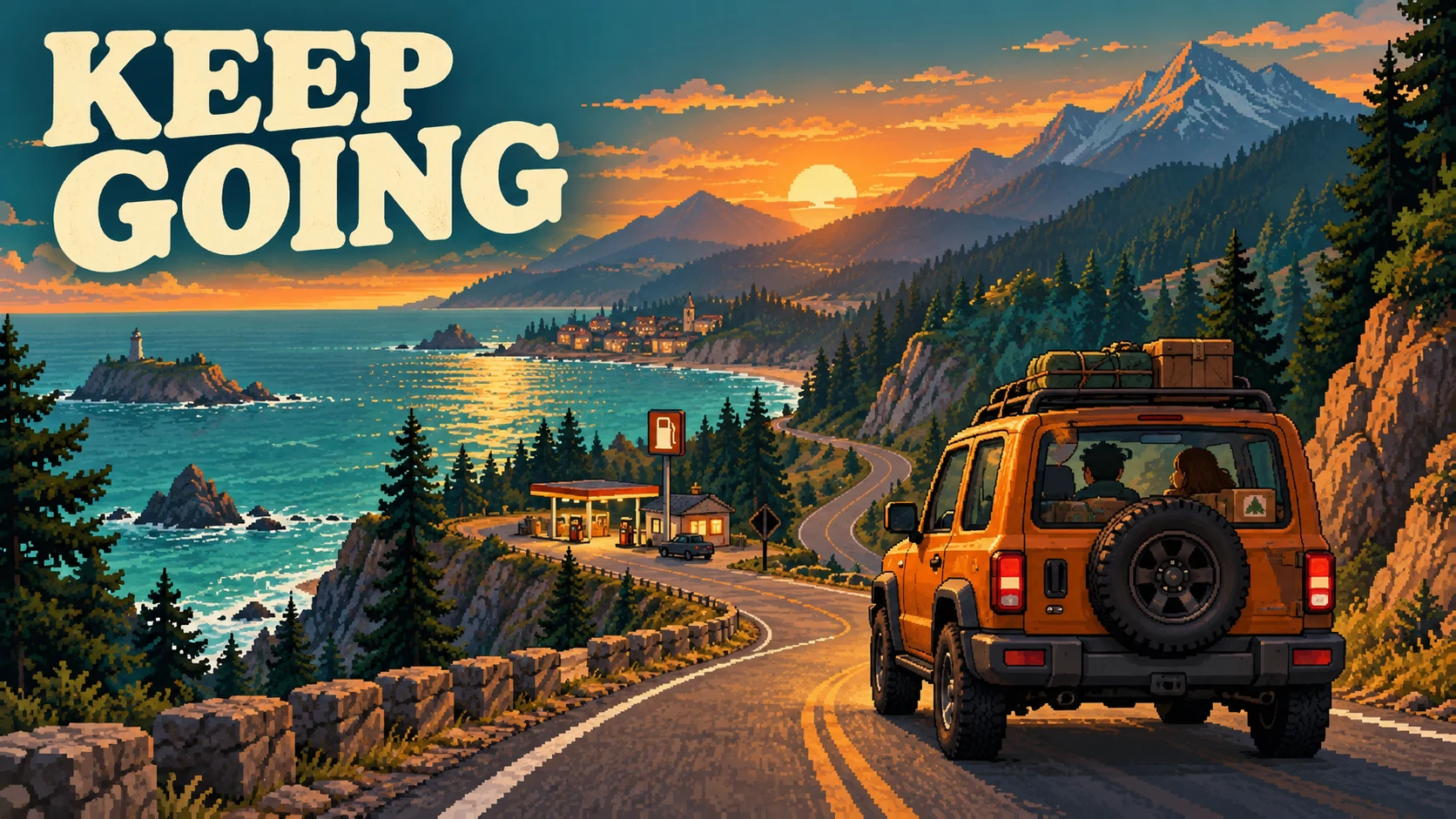
A road trip built for the browser
Keep Going: Pixel Road Trip is an original H5games browser game about driving, meeting passengers and managing a journey. Its web project uses Phaser 3.90.0, TypeScript and Vite. Phaser handles the game scene and rendering; TypeScript provides the code structure, and Vite produces the files delivered to the browser. Vite is the build tool, not the game engine.
The project owner identifies GPT6 ASTRA as the lead AI for programming and art production. The art records also document the built-in image generation tool, with prompts and source versions kept alongside the assets. The useful distinction is between directing a visual, generating it and making it work inside the game: these are separate steps.
Why a beautiful coast still needs engineering
A scrolling background can expose problems that are invisible in a still image. In this project, mirroring a combined sky-and-coast image produced repeated pairs of clouds. The recorded revision separated cloud artwork from the background. Cloud layers could then move at different speeds without flipping the sky.
A later coast revision used an asymmetric shoreline whose ends returned to open water. That gave the runtime a less conspicuous place to overlap the scrolling image. The lesson is practical: ask for a scene designed to repeat, and test the seam while driving. A wide illustration alone does not guarantee a convincing loop.
Turning AI art into a moving scene
The environment records describe separate road and coast TileSprites, with restrained shader motion for water and foliage. The road surface and guardrails are excluded from plant movement. Environment animation also uses time independently of distance travelled, so stopping the car does not stop the sea.
This is not a claim that every element is generated. The documented pipeline includes small birds drawn procedurally in code. AI-generated source art, conventional rendering and code-driven effects can coexist in an original game. The practical goal is a coherent scene, not a requirement that every pixel have the same origin.
A reusable prompt and review checklist
For a new asset, a useful brief is: “Original pixel-art coastal panorama for a side-scrolling driving game. Keep the horizon level, return both horizontal edges to open sea, and separate clouds into transparent layers. No lettering, logos or recognizable existing game characters.” This is an illustrative prompt, not a quotation of the original production prompt.
Review the generated image at the actual game scale. Check horizon alignment, repeated landmarks, transparency and readability behind the car. Preserve the approved source, export a separate runtime version, and test scrolling before producing more scenery. Keep Going's project records retain prompts and numbered revisions so a visual change can be traced and reversed.
Production credit and sources
Original H5games production. The project owner credits GPT6 ASTRA with leading programming and art production. These articles combine that account with project code and production records and were prepared with AI assistance. Example prompts are educational reconstructions, not archived production prompts. AI-generated assets are not a guarantee of copyright clearance.
Technical descriptions refer to the browser editions. Sources include their dependency files, renderer code, asset-integration notes and deployment records. This article describes selected production work, not an independent legal review.