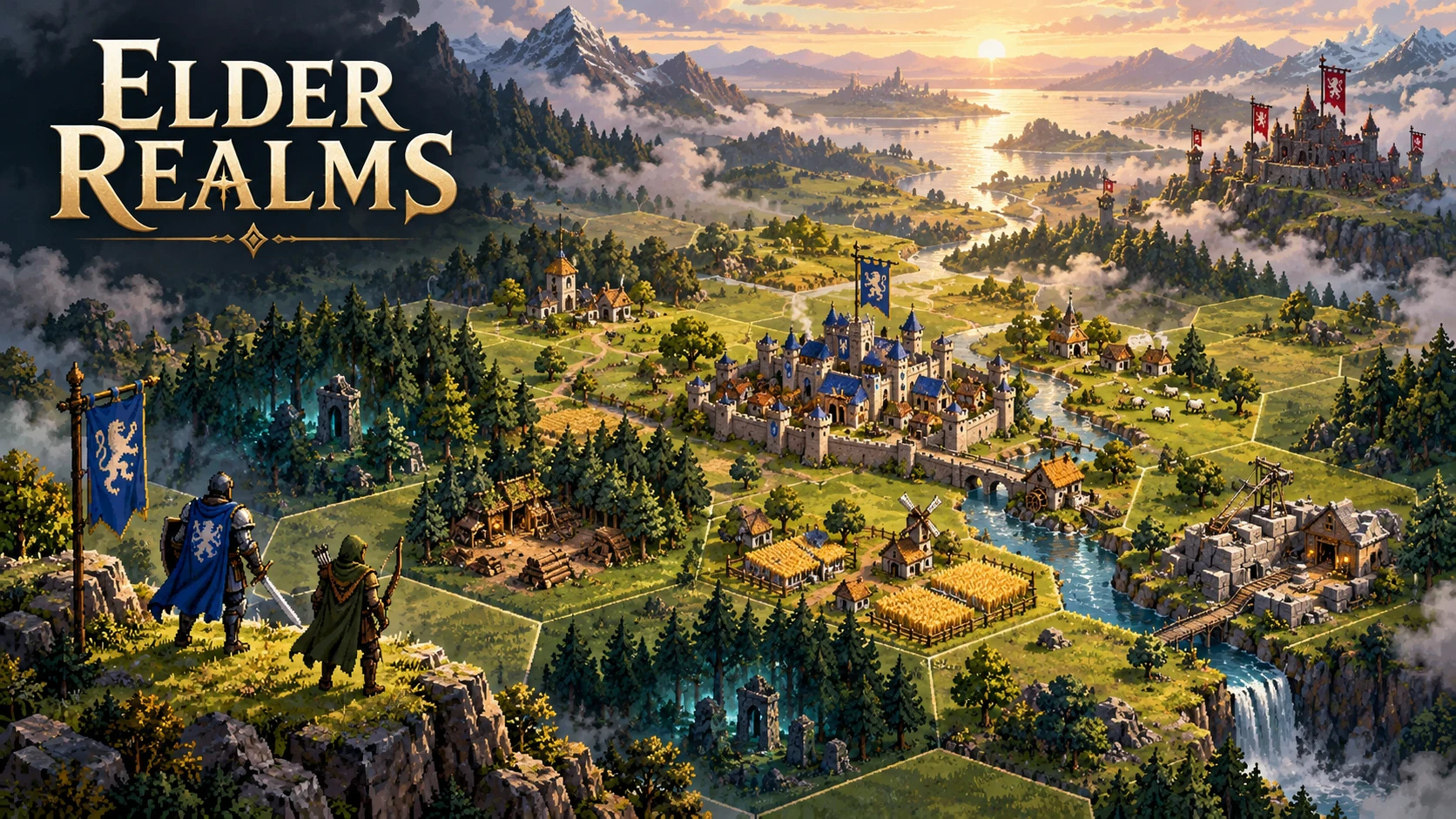
The engine behind the web edition
Elder Realms: Kingdom Strategy is an original H5games strategy game built around a hex-grid world, settlements and turn-based decisions. The deployed web project's dependency file identifies Phaser 3.90.0, TypeScript and Vite. These are the technologies discussed here; the name of an older project folder is not the name of the web engine.
According to the project owner, GPT6 ASTRA leads programming and art production. Project documentation records image generation for assets including food resources and settlement buildings. The AI supplies assistance and generated source artwork; the game still needs explicit rules for tile placement, state changes and interaction.
Designing art that works on a map
A strategy map asks more of an image than a poster does. Terrain needs to connect across cells. A building should remain identifiable when the camera zooms out. A resource icon must be distinct from the ground under it. Generating these as separate asset families makes them easier to position and revise.
The project records include dedicated berry and sheep resources, alongside plantation and sheep-ranch artwork. These are useful examples of separating what a tile contains from the tile itself. A resource can change or a building can be added without regenerating an entire map illustration.
From individual images to atlases
The web project's asset documentation describes converting individual source images into texture atlases while retaining the originals. An atlas groups images into a larger texture and records the rectangle occupied by each frame. The game can then reference a named frame instead of treating every image as an unrelated file.
That conversion has to preserve transparent margins and frame coordinates. A correct-looking atlas can still be wrong if its metadata cuts off a roof or moves a unit's feet. The recorded pipeline compares cropped frames against their source pixels. This is a valuable check because the screenshot of a whole atlas can conceal small boundary errors.
An art brief for strategy assets
An example brief for a new building is: “Original small settlement building for a readable hex-grid fantasy strategy map. Match the established camera angle and lighting. Use a clear roof silhouette and transparent surroundings. No text, logos or recognizable franchise architecture.” This is a suggested workflow prompt, not a historical quotation.
Before adding a complete building set, put one result on the map beside an existing unit and terrain tile. Check its footprint, overlap and zoomed-out visibility. Keep the visual footprint separate from movement and occupancy rules. A decorative roof extending beyond one hex should not silently change which cells a unit can enter.
Production credit and sources
Original H5games production. The project owner credits GPT6 ASTRA with leading programming and art production. These articles combine that account with project code and production records and were prepared with AI assistance. Example prompts are educational reconstructions, not archived production prompts. AI-generated assets are not a guarantee of copyright clearance.
Technical descriptions refer to the browser editions. Sources include their dependency files, renderer code, asset-integration notes and deployment records. This article describes selected production work, not an independent legal review.