A custom renderer, not a large engine
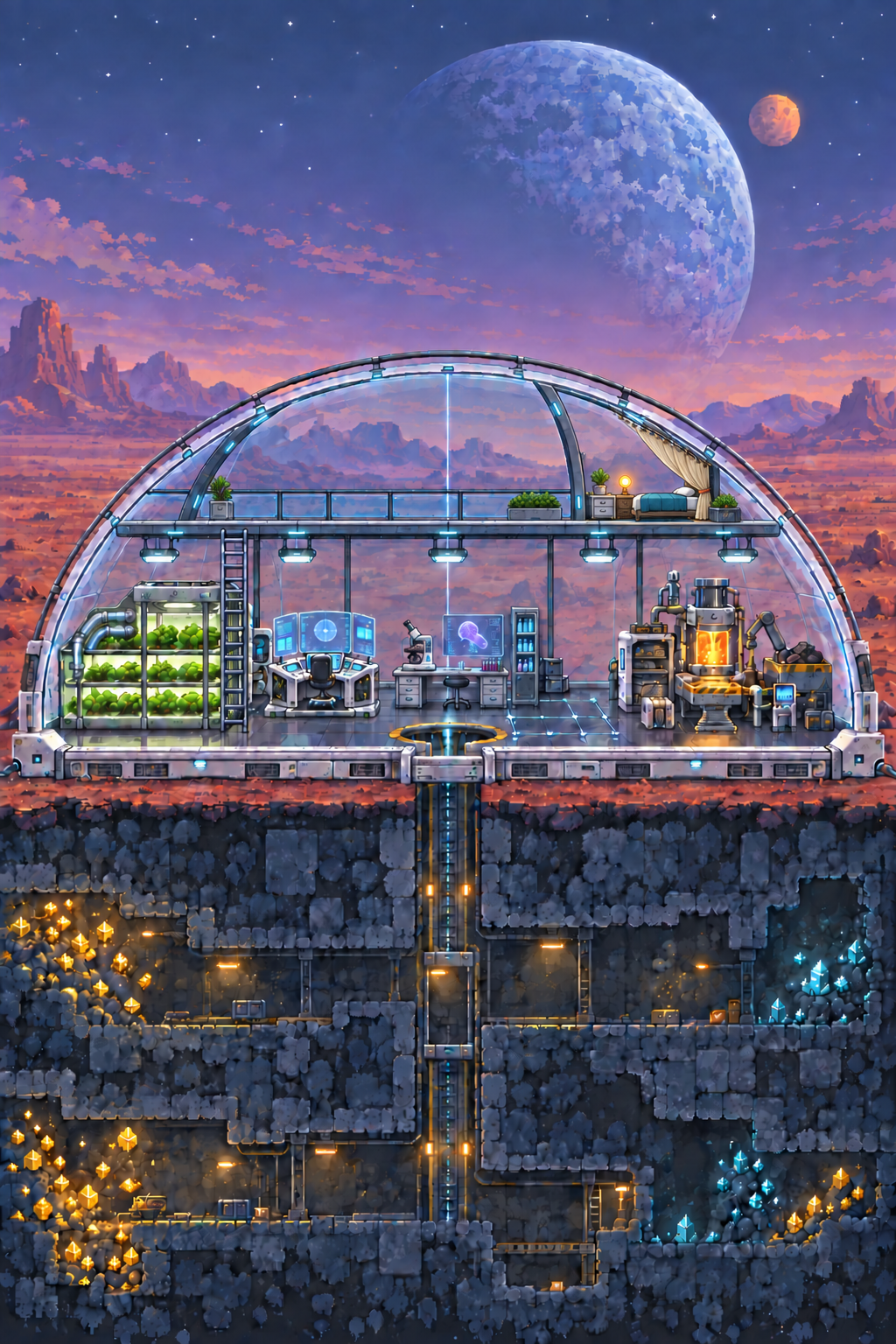
Planet Guardian is an original H5games game about an outpost, underground resources and the defense of a glass dome. The current web code creates a Canvas 2D drawing context and implements its game behavior in JavaScript. Unlike our Phaser-based projects, this edition does not depend on Phaser for its renderer.
The project owner identifies GPT6 ASTRA as the lead AI for code and art production. Asset prompt records also identify the built-in image generation tool. Canvas is the display technology; the AI-assisted workflow is how code and source artwork are developed. These should not be confused with a runtime AI service.
Break the dome into useful layers
A finished illustration of a glass outpost looks convincing because its parts overlap: glass, frames, rooms, machinery and the landscape behind them. A playable game needs to control some of those parts separately. The project records describe source-art slicing, independent characters and weapons, and separate visual treatment for damage.
This lets the game preserve the scene's art direction while changing the dome's condition. Glass highlights and cracks are a two-dimensional presentation of its state, not a real-time simulation of optical refraction. Keeping that boundary clear helps focus development on whether the player can read the dome's condition during play.
Mining needs visual and logical layers
The underground is another place where a single image is insufficient. A rock can be intact, removed or part of a mineral deposit. The renderer has to show the current condition of each section as the player digs. Project notes describe grouped mineral artwork being removed in pieces as its underlying cells are mined.
The visual treatment of a tunnel should follow the boundary between open space and solid terrain. Drawing a border around every empty cell would turn a connected passage into a visible grid. This is a useful example of AI-generated texture becoming one ingredient in a procedural drawing system.
Preparing art for a responsive game
An illustrative brief is: “Original side-view sci-fi outpost under a glass dome. Deliver the background, structural frame, room machinery and damage overlays as separate compatible layers. Keep perspective and lighting consistent. No written labels or existing franchise imagery.” The brief describes a workflow; it is not the archived original prompt.
After generation, inspect layer edges and test the scene at the game's close and distant views. Keep essential indicators clear of touch controls. The recent asset-compression work also preserves image dimensions and transparency, because changing either can invalidate carefully aligned layers. Smaller downloads help loading, but visual alignment and readable damage feedback still need their own review.
Production credit and sources
Original H5games production. The project owner credits GPT6 ASTRA with leading programming and art production. These articles combine that account with project code and production records and were prepared with AI assistance. Example prompts are educational reconstructions, not archived production prompts. AI-generated assets are not a guarantee of copyright clearance.
Technical descriptions refer to the browser editions. Sources include their dependency files, renderer code, asset-integration notes and deployment records. This article describes selected production work, not an independent legal review.